March 23rd, 2010
This is Passport to Texas
At the end of January, two vessels collided in the port of Port Arthur; one was an oil tanker carrying crude, the other a barge towing ships.
This is the largest spill that Port Arthur’s seen in a very long time.
Winston Denton is a Texas Parks and Wildlife biologist who was at the site of the January 23 incident.
The Eagle Otome is an oil tanker; it was coming into Port Arthur [when the accident occurred]. Okay, we’re looking at the barge that was involved in the collision with the ship. The barge just hit it and went right inside the ship.
It’s estimated that 450-thousand gallons of crude spilled into the water… which translates to approximately 11-thousand barrels of oil.
Prior to this, what we considered a large spill was two to three thousand barrels; and this is, like, four times that.
Hundreds of people, including from parks and wildlife and the US coast guard, mobilized to mitigate damages and clean the spill. Booms stopped oil from migrating down the intercostal waterway into sensitive wetlands. More than a dozen animals died from the spill, but others were trapped, cleaned and saved.
That’s one more…I think he’ll make it.
At the time we recorded this show, oil sheen remained on the water.
That’s our show…with support from the Sport Fish Restoration Program… For Texas Parks and Wildlife…I’m Cecilia Nasti.
Posted in Conservation, Saltwater, SFWR | Comments Off on Oils Well That Ends Well?
March 22nd, 2010
This is Passport to Texas
The April issue of Texas Parks and Wildlife magazine, on newsstands now, will inspire families to get outside, and to maybe even do volunteer work. Editor, Louie Bond.
So, our idea this month is to get families out fishing together. So, we’re going to take you on six excellent family fishing vacations in Texas, and hope that you’re inspired to take your kids out, spend a weekend or a week out there, just with you and the water and a pole and lots of beautiful silence.
Then, another feature that I think is really special this month is the restoration of Galveston island State Park, which, of course was devastated by Hurricane Ike. There were a lot of questions at the time about the fate of Galveston Island State park, because it was so badly damaged, and there’s a great group of volunteers that were already in place, called the Friends of Galveston Island State Park. But, decided—here’s our call to action—and in they came, and they cleaned up trash, and they got stuff hauled away.
And most importantly, they found partners from everywhere. And, all of these different entities came together and did their part; there’s a lot to redone there, but it looks better than ever. So, people can actually come out this year and enjoy the park—and it’s a great success story.
Thanks, Louie!
That’s our show… with support from the Sport Fish and Wildlife Restoration Program…For Texas Parks and Wildlife…I’m Cecilia Nasti.
Posted in Conservation, Fishing, SFWR, TPW Mag | Comments Off on TPW Magazine April Preview
March 19th, 2010
This is Passport to Texas
Nightfall offers state park visitors a different perspective.
Make tracks to Inks Lake State Park in the Hill Country on the night of Saturday March 27, for their Moonlight Hike and Owl Prowl. Bring your flashlights and walking shoes and be prepared to listen to some strange sounds on your night out. [Male voice spouting cheesy pick up line] Wrong kind of night out. [Screech owl] That’s more like it.
You’ll meet at the Amphitheater to learn about owls and trail safety. [Sound effect of someone slipping and falling]. Um…watch your step. Later, you’ll explore the sights and sounds on the trail under a near full moon, and later you’ll call the owls to you. Kids 12 and under must be accompanied by an adult; no pets please… [Cat hisses] …deal with it.
On that same night, across the state, at Palo Duro Canyon State Park, you can take part in a guided night hike. What can you see in the canyon at night? Whatever it is…don’t feed it after midnight. [Short snippet from movie Gremlins] Reservations are required for this trek…and the deadline to make them is March 25.
On the evening of March 29, Estero Llano Grande SP, which is part of the world birding center, is hosting a Full Moon Party. Come celebrate the full moon [Wolf howl] and see all that the park has to offer after hours.
Find information on these events in the calendar section of the Texas parks and Wildlife website.
For Texas Parks and Wildlife…I’m Cecilia Nasti.
Posted in Events, State Parks | Comments Off on Night Moves
March 18th, 2010
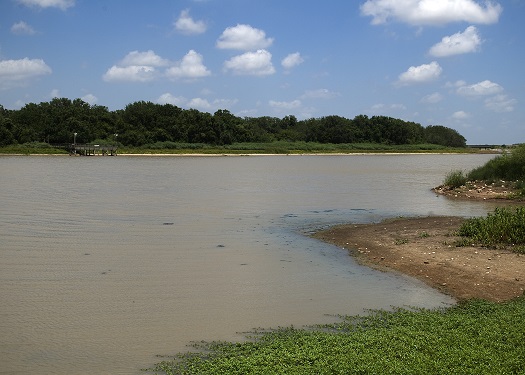
Lake Texana
Passport to Texas
In 1832, Dr. Francis F. Wells—a member of Stephen F. Austin’s Old 300—founded a town along a bend of the Navidad River, which eventually became known as Texana.
This was the western most settlement of Austin.
Cindy Baker is the interpretive ranger at Lake Texana State Park. She says Texana was a thriving community; it was in a good location, had abundant natural resources, and a shallow water port. It could have been great, if not for some short sightedness.
Two brothers showed up and offered for 100-thousand dollars to buy the town. Mr. Wells said, ‘No. We want 200-thousand. We love our town.’ And the two brothers—wanted to build a deep water port—so they went east, they found the Buffalo Bayou, they dug their deep water port, and they called it Houston.
But that’s not all… In 1883 the New York, Texas and Mexican Railway bypassed the settlement.
A man named Telferner came through and said, ‘For 30-thousand dollars, I’d like to put my railroad stop here in your town.’ And they said, ‘A railroad? We have a port. We don’t want your dirty old railroad.’ He moved seven miles north, and he named that stop after his daughter Edna. Within two years, everyone picked up and moved to Edna.
Making Texana a ghost town… Today the remains of the town sit at the bottom of Lake Texana, created in 1979 when the Lavaca-Navidad River Authority, built a dam on the Navidad River.
That’s our show… For Texas Parks and Wildlife…I’m Cecilia Nasti.
Posted in Historic Sites, State Parks | Comments Off on Texans: The Forgotten Town
March 17th, 2010
This is Passport to Texas
Farmers know how costly it can be to spray crops with insecticides to prevent pest damage. What some may not know is…bats can be partners in pest eradication.
The Mexican free tail bat, in particular, is really valuable for agricultural purposes.
Meg Goodman is a former Parks and Wildlife’s bat biologist.
Current research has shows that these bats can save farmers up to two sprays of pesticides per year because of all the insect pests that they’re eating, like the corn earworm moth and the cotton boll worm moth, among other crop pest species.
In the early 20th century, San Antonio physician Charles A. Campbell designed and tested artificial roosts to attract bats to eat mosquitoes blamed for the spread of malaria. Eventually Campbell developed a bat tower, which he installed at Mitchell Lake, south of the city, which attracted hundreds of thousands of the flying mammals. The spectacle of the bats’ nightly emergence drew spectators in the 1920s…as it does today, wherever bats roost.
Their numbers and nightly emergences bring in a lot of tourist dollars to a lot of smaller communities—and big communities like Austin… It’s one of our top tourist destinations. But they do provide a lot of tourist dollars through nature tourism through a lot of our smaller communities throughout the state.
Learn how to attract bats at passporttotexas.org. That’s our show…we receive support from the SPWR program.
For Texas Parks and Wildlife…I’m Cecilia Nasti.
___________________________________________________________________
Keep Texas Wild–Bat Issue
Bat House Information
Posted in Education, SFWR, Wildlife | Comments Off on Beneficial Bats


 Passport to Texas is a
  Passport to Texas is made available by: