January 19th, 2010
This is Passport to Texas
The best time to get to know your land is when you first buy it.
Walk it; look at it carefully. Study it over the seasons. Really find out what makes it tick. And, that’s the first step – to really understand the land – and then understand the management that it takes to achieve the kind of goals you want for your recreation.
Linda Campbell directs the private lands program at Parks and Wildlife, from which landowners receive help with their management goals. She recommends getting started by visiting the workshop calendar – in the private lands section – on the TPWD website.
These are workshops and field days and things of that nature that occur all over the state. And so I would suggest landowners take a look at that.
Attending these events allows landowners to get to know other like-minded people in their region. The agency also offers free on site technical assistance in wildlife management planning.
And so, we look at the entire picture – all the habitats that are there, what can be done, what are the landowners goals, and then we help them develop a plan that will help them achieve that.
Tomorrow, joining with adjacent landowners to form a wildlife management association.
That’s our show. We receive support from the Wildlife Restoration program.
For Texas Parks and Wildlife…I’m Cecilia Nasti.
Posted in Land/Water Plan, SFWR | Comments Off on Recreational Landowners: Knowing Your Land
January 18th, 2010
This is Passport to Texas
As our population becomes more urban, we see people buying rural property as weekend retreats.
Recreational buying is the greatest motivation for exchanges in land in Texas.
Linda Campbell, who directs the private lands program at parks and wildlife, says the reasons for buying rural property are as different as the people buying it.
Game species are still a big driver – very important economically for landowners in Texas, and for the communities that are supported by this. But, we have a greater diversity of landowners, and so with a diversity of people, you have a diversity of interests. So, there are a lot of landowners, particularly those with smaller tracts that are primarily interested in managing for birds and other non-game wildlife. Or, they just want to get away from the city to have a retreat. And that’s an absolutely valid goal as well. And, so, we work with all landowners in whatever their goal is.
Parks and Wildlife’s private lands program offers landowners free technical assistance managing their property.
Texas is over ninety percent privately owned, and so we recognized that if we’re going to have any impact at all on conservation of wildlife and habitats, we have to do it through the cooperation of private landowners.
Understanding your land…that’s tomorrow.
That’s out show…we receive support from the Wildlife Restoration program.
For Texas Parks and Wildlife…I’m Cecilia Nasti.
Posted in Land/Water Plan, SFWR | Comments Off on Recreational Landowners: Buying Rural Land
January 15th, 2010
This is Passport to Texas
If you find yourself in a nostalgic or contemplative mood, you’ll get particular enjoyment from February’s issue of Texas Parks and Wildlife magazine. Editor, Louie Bond.
I think in February we have some real treats for you. And two in particular really stand out. The first is a really lyrical piece by Russell Graves who grew up along the Bois’dArc Creek, and he and his brother spent many happy years there hunting and fishing and exploring and doing all those great things little boys do. And now the creek is being flooded to provide a reservoir, and he and his brother have taken one last trip down the creek and chronicled it with words, photographs, and even film; they’re going to make a little documentary on it. So, we’re bringing you the words and the photos, and on our website, some of the documentary work as well.
While you’re curled up in your armchair, if you’d like a little more to read, there’s a special Legend, Lore & Legacy on John Winter, who was a real Renaissance Man around the turn of the Twentieth Century. And avid outdoorsman who also happened to be a spectacular photographer. We came across these wonderful photographs and we knew there was a story behind the photographs. And, our own John Jefferson who’s quite a Renaissance Man, himself, really was fascinated by John Winter. And so it’s interesting the take of a Renaissance Man from one century chronicling the Renaissance man from a previous century.
Thanks Louie.
That’s our show… For Texas Parks and Wildlife…I’m Cecilia Nasti.
Posted in TPW Mag | Comments Off on TPW Magazine February Preview
January 14th, 2010
This is Passport to Texas
Being invited to participate in a snipe hunt fills young hearts with anticipation and anxiety. In my youth, snipe hunts were cloaked in mystery; and that’s what made them so exciting and terrifying.
Taken at night to a wooded area, and outfitted with a burlap bag…a flashlight with weak batteries…and a whistle to call for help… initiates would enter a wooded area alone in search of dreaded snipes. And how would they recognize them? They were informed they would know them when they saw them.
Well, before long, panicked whistles and screams from deep within the woods pierced the silence, as vivid imaginations got the best of the young snipe hunters. Eventually everyone, including the hunter, had a good laugh.
Today we know snipe are small, long billed, brownish shorebirds in the sandpiper family. Their habitat includes freshwater marshes, ponds and flooded fields. They breed across much of North America, but like to spend their winters in the southern states, including Texas.
Snipe are game birds here, and the season to hunt snipe ends on February 13th. So if you want to go snipe hunting, and not be left holding the bag, time is running out.
That’s our show… made possible by the Sport Fish and Wildlife Restoration Program…working to increase fishing, hunting, shooting and boating opportunities in Texas.
For Texas Parks and Wildlife…I’m Cecilia Nasti.
Posted in Birding | 1 Comment »
January 13th, 2010
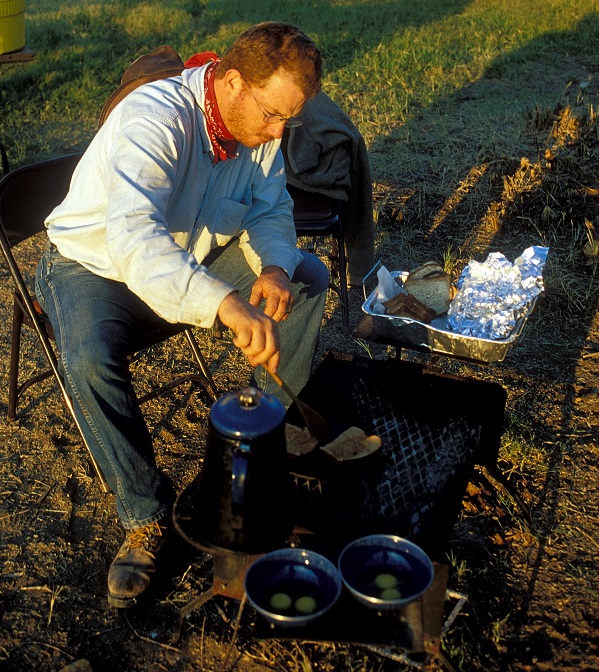
Campfire cooking
This is Passport to Texas
As author of the Texas Campground Cookbook, Roger Arnhart knows a few things about food preparation. He’s perfected recipes for everything from pot roast to pastries – creating his culinary masterpieces in rather out of the way locales, with unusual low tech equipment.
If you’re ready to test your campground culinary creativity, Arnhardt says two pieces of cooking apparatus that no open-air chef should leave home without are a cookie sheet and four aluminum soda cans…emptied.
A pit grill is a wonderful thing to cook on. Unfortunately the grill is fixed so you can’t control how high that grill is over your fire. So one of the things that I recommend that every camper does, is go buy aluminum cookie sheets. Along with what I call my riser, those are coke cans, put that cookie sheet on top of the coke cans and you can bring it up to the proper height. If it’s too high you can crush the coke cans and make it about a three-inch riser. And then you start your charcoal on the cookie sheet, under a pit grill.
He says a cookie sheet also comes in handy when cooking on a waist-high grill.
Put your charcoal on the cookie sheet, and then slide the cookie sheet under the waist high and you’ve got a perfect fire. And when you’re done cooking you let the fire burn out and the next morning all of your coals are in your cookie sheet, to dispose of them properly.
Find more ways you and your family can get the most our of the outdoors on the TPWD web site.
That’s our show for today…thank you for joining us. For Texas Parks and Wildlife, I’m Cecilia Nasti.
Posted in Camping, howto | Comments Off on Campfire Cooking


 Passport to Texas is a
  Passport to Texas is made available by: