July 13th, 2018
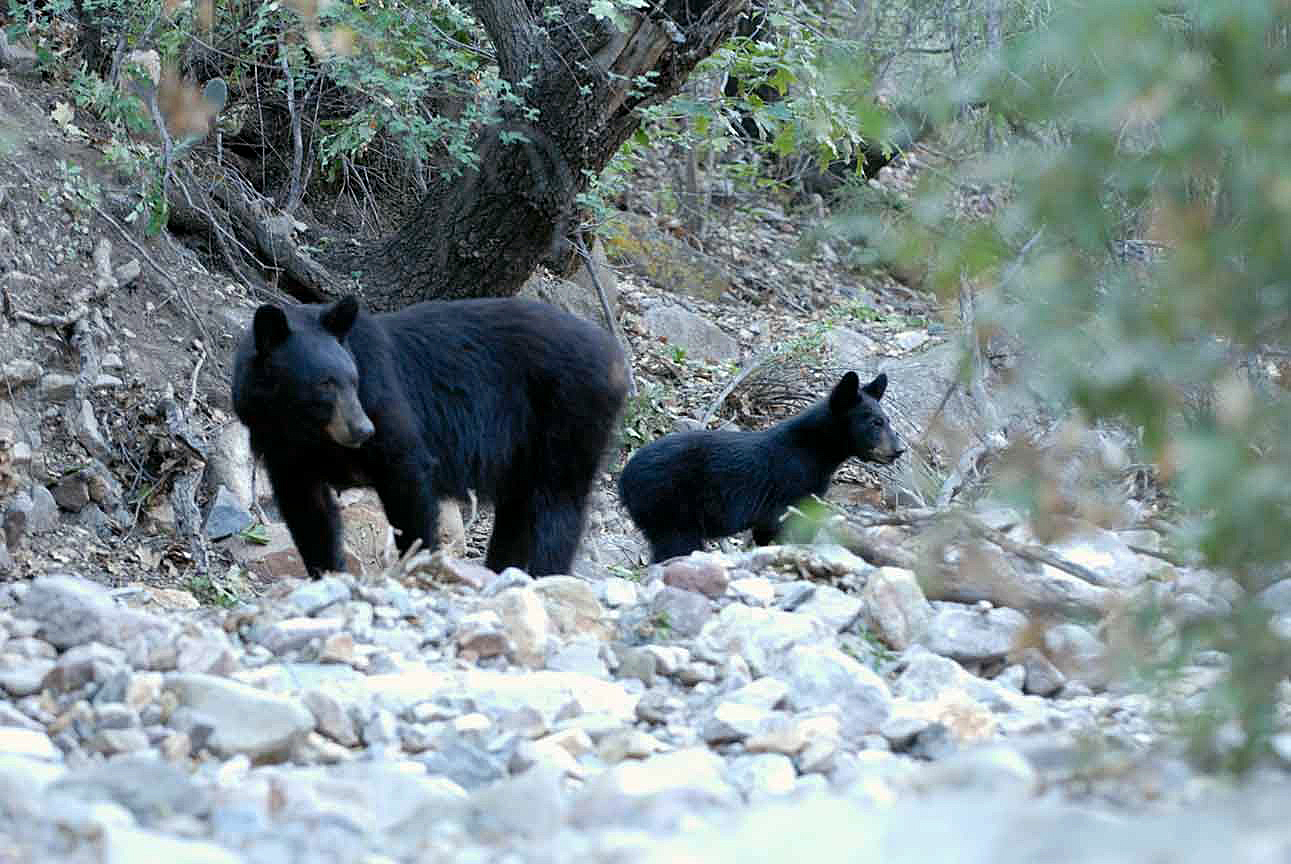
Mother Black Bear and cub in Big Bend National Park.
This is Passport to Texas
Smiley Nava served as borderlands biologist at Texas Parks and Wildlife before retiring. His job involved understanding and developing conservation strategies for the natural resources along the shared border between Texas and Mexico.
We have ecosystems; we have natural resources that we share between Mexico and the state of Texas. We’re talking about an area that is a little over 12-hundred miles in length – from El Paso, Ciudad Juarez – to the mouth of the Rio Grand. And that’s all inclusive of the area that is my project.
Nava identified local, state and governmental partners in Mexico to join this mission. During his tenure, Nava said one border city, in particular, lead the way.
The City of Nuevo Laredo, they have an ecological department. It’s a sub directoria de la ecología – as it’s called — subdirectory of ecology. They make sure that there’s conservation implemented… if they’re clearing out trees that they’re replanted with native vegetation. And they’re very proactive… They’re setting the example and showing their other cities along the border how this can work and be beneficial.
Learn more about Borderlands Ecology and other conservation topics on the Texas parks and Wildlife website.
The Wildlife Restoration Program supports our series.
For Texas Parks and Wildlife…I’m Cecilia Nasti.
Posted in Wildlife, Wildlife and Sport Fish Restoration Program | Comments Off on Borderland Ecology
July 12th, 2018
Big Bend National Park. On the border.
This is Passport to Texas
Borders are political demarcations, conceived of by man. Nature, meanwhile, knows no such boundaries.
The boundary to Texas and the United States doesn’t stop midway in the Rio Grande. It goes all the way to the Mexican side as far as the resources are concerned.
Smiley Nava retired from Texas Parks and Wildlife where he served as its borderlands biologist. His work focused on the natural resources along the 12-hundred mile border shared between Texas and Mexico.
We are specifically looking at the state natural resources that we share with our four Mexican states. We’re right at around fifty percent of the US/Mexico border, so Texas is an important component of those shared resources.
The area Smiley oversaw is diverse.
The Tamaulipan scrub land is one of the provinces that are prominent for a good part of our border that we share with Mexico. The other part, the upper basin of the Rio Grande, as you move inland, is more typical of the Chihuahuan desert. So the species utilize those, what natural resources and components we share with Mexico in those regions, kind of drive where we’re trying to focus our work.
The Wildlife Restoration Program supports our series.
For Texas Parks and Wildlife…I’m Cecilia Nasti.
Posted in Wildlife, Wildlife and Sport Fish Restoration Program | Comments Off on Wildlife Ignores Borders
July 11th, 2018
Roseate Spoonbill on Texas coast.
This is Passport to Texas
Legendary Birder, Victor Emanuel, views birding as a gateway to nature appreciation.
Well, it’s the best way for people to get connected to nature, because birds are the most obvious part of nature visible to us. A lot of the mammals are active at night. But birds are here; they’re all around us.
Emanuel says it’s the fact that they are so visible that makes them interesting.
Birds are some of the most visible creatures around us. You have the song of birds, you have the motion of birds, the fact they can fly. A cardinal, a blue jay, a duck on a pond… they’re large enough and so they attract our attention in a way that smaller creatures don’t.
Victor Emanuel has spent a lifetime watching birds around the world. And while all birds are watchable, he says that doesn’t mean he likes them all.
I actually have a prejudice against introduced birds that are a problem, like starlings. They’re a beautiful bird, actually, with the colors on them in the sunlight. But they take over the nest of native birds, and throw out the young and eggs, so they don’t get to raise their young and eggs. But, yeah, they’re all watchable.
Find birding information on the Texas Parks and Wildlife website.
That’s our show for today…For Texas Parks and Wildlife…I’m Cecilia Nasti
Posted in Birding | Comments Off on Birding: Gateway to the Natural World
July 10th, 2018
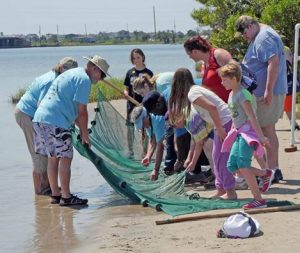
Examining marine life in sein net.
This is Passport to Texas
We call searching the Internet surfing. But, we call searching a net that’s been in the surf, seining.
Seining is dragging a long net through the water, catching small fish and aquatic animals.
Hans Haglund is superintendent at Galveston Island State Park. He says the bay waters are teaming with all kind of life. And he’s taken more than a few visitors seining in Galveston Bay.
We do it to help educate about the bay, the wetlands, the environment out here; to show people how important they are, how productive they are, what these areas do for us, why we might need to protect them and look out for them.
Abundant, healthy wetlands can help to mitigate potential flood damage, as well as serve as nurseries for marine life. Haglund describes visitor reactions to what they catch in their seine nets.
Oh, I never know that was out there, and I never knew you could get so much in a little area. Even people that have been using the bay a lot – a lot of fishermen – don’t realize how productive these areas are.
Some of the more unusual fish Haglund says they see include the pipe fish and lizard fish.
Summer’s here, and Galveston Island State Park offers a great coastal getaway. Learn more at texasstateparks.org.
The Sport Fish Restoration Program supports our series…and works to increase fishing and boating opportunities in Texas.
For Texas Parks and Wildlife…I’m Cecilia Nasti.
Posted in Education, Saltwater, SFWR, Texas Aquatic Science Program, Water | Comments Off on Bay Seining in Texas
July 9th, 2018

Tony Amos. Image: Earl Nottingham, TPWD.
This is Passport to Texas
Shortly after Anthony “Tony” Amos joined the University of Texas Marine Science Institute in Port Aransas in 1976, he began patrolling a seven-mile stretch of beach every other day.
That’s how Melissa Gaskill begins her article for the July issue of Texas Parks and Wildlife magazine; it’s a tribute to Tony Amos, a man who lived and shared his passion for the understanding and conservation of marine life.
He passed away in September of 2017, but his legacy lives on among those who knew him and worked with him. Melissa writes: One of Amos’s best-known achievements is the Animal Rehabilitation Keep, or ARK, which came about somewhat by accident.
He came across oiled birds and sea turtles on his beach patrols after a 1979 oil spill in Mexico’s Bay of Campeche, and brought them to the MSI campus… building shelters for the birds and putting the sea turtles in unused tanks.
That ad hoc effort grew into a thriving marine wildlife rehabilitation facility with a sea turtle building and outdoor bird enclosures. The MSI renamed it the Amos Rehabilitation Keep in August, 2016.
Read Melissa Gaskill’s story about Tony Amos’ life and legacy in the words of those who knew him, in the July issue of Texas Parks and Wildlife Magazine. On newsstands now.
We receive support from RAM Truck: built to serve.
For Texas Parks and Wildlife…I’m Cecilia Nasti.
Posted in TPW Mag | Comments Off on TPW Magazine: Remembering Tony Amos


 Passport to Texas is a
  Passport to Texas is made available by: