July 6th, 2018
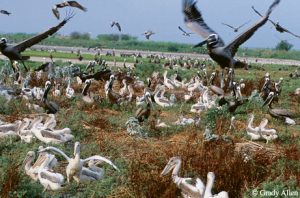
Rookery. Photo by Grady Allen from TPW Magazine.
This is Passport to Texas
When it’s nesting time for birds along the Gulf Coast, it’s time for humans to keep their distance and to be careful not to disturb them.
If you see a group of birds on an island, anywhere between say March and August, and they’re acting kind of conspicuously, they’re probably nesting. And if all of a sudden you see a whole bunch of birds getting up and flying off then you’ve already gotten a little bit too close.
David Newstead is an Environmental Biologist with Coastal Bend…Bays and Estuaries. He’s on next week’s Texas Parks and Wildlife TV series on PBS. Nesting is a critical period in the life cycle of the birds. Without a safe place to nest the overall population of coastal water birds will decline.
When people get a little bit too close to nesting birds that can have a pretty catastrophic effect on the nesting success of the birds. Getting too close can actually cause a panic reaction and scatter birds. When they move from the nest they are actually leaving those eggs and chicks completely exposed. And birds and chicks, they can’t thermo regulate very well at all so they rapidly overheat. And the eggs of course can’t thermo regulate at all. In this hot Texas heat, in the middle of nesting season, getting birds off of nests and chicks for just a couple of minutes can result in death or cooking of the eggs. They say you can cook an egg on the sidewalk, you’re basically cooking eggs on the island.
Check out the segment Guarding the Nest the week of July 8 on the Texas Parks and Wildlife TV series on PBS. Check your local listings.
The Wildlife and Sport Fish Restoration Program support our Series.
For Texas Parks and Wildlife…I’m Cecilia Nasti.
Posted in Birding, Conservation, TPWD TV | Comments Off on TPW TV: Guarding the Nest
July 5th, 2018
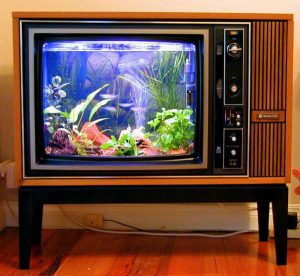
Aquarium in TV. Image: Furnish Burnish
This is Passport to Texas
How far would you travel to ensure the future of your favorite exotic aquarium fish?
We had some folks telling us that they would go as far as 50 miles to find an appropriate body of water.
Releasing pet fish into Texas waters when you no longer want them, is not a humane act. Exotic aquaria species disrupt natural ecosystems.
When we spoke, Priscilla Weeks was a research scientist at the Houston Advanced Research Center. At the time, her team used a TPWD grant to research why people release their fish into Texas waters.
I think there might be a stereotype where folks think that it is easy, emotionally, just to release a fish. But actually what we’re finding is folks are very attached to their pets.
According to research, whether a person gives up their fish depends on personal preference like its behavior or physical attributes.
And what we’re finding is that different individuals prefer different attributes of a fish. So, it’s not necessarily that it grows too big in my tank, because I may like a big fish.
If those attributes change, sometimes so does the owners’ interest in the animal.
Releasing a fish is not the only option when you no longer want it. Weeks says you can euthanize it, but less drastic is taking it back to the pet store.
The Sport fish restoration program supports our series.
For Texas Parks and Wildlife, I’m Cecilia Nasti.
Posted in Fishing, Habitat, Regulations, Water | Comments Off on Releasing Aquarium Fish Not Humane
July 4th, 2018
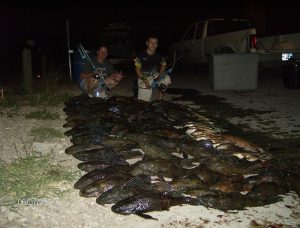
What happens when well meaning citizens release the “sucker fish” (Plecostomus) from their aquarium into the wild?…they grow and multiply! Picture from Lake Dunlap, TX.
This is Passport to Texas
Remember this?
He’s gonna get out of here. He’s going to get flushed. What a smart little guy!
We love how in the Pixar animation, Finding Nemo, the aquarium fish escape into the wild. The problem is most fish in Texas aquariums aren’t from here.
Luci Cook-Hildreth is a fisheries biologist, formerly with Texas Parks and Wildlife’s Inland Fisheries Division.
Even really smart people sometimes don’t understand that a fish is not just a fish and water is not just water. They go, “I have a creek in my backyard, and I have a fish that’s too big for my tank. Well, why don’t I just set him free?” And they don’t understand that there’s a lot of biological and ecological ramifications to that decision.
When these fish thrive in Texas waters, they out-compete native fish populations.
Moreover, it’s nearly impossible to control what species of fish people own because of the Internet. Despite state laws, there seems to be a constant supply—and demand—for illegal species. For good reason.
Folks that are interested in selling illegal fish have the potential to make thousands of dollars on these fish. And we can slap a fine on them, for 200 or 300 dollars, and it’s really just the cost of doing business for these folks.
Releasing one fish into the wild might endanger many more.
The Sport Fish Restoration Program supports our series.
For Texas Parks and Wildlife, I’m Cecilia Nasti.
Posted in Fishing, Habitat | Comments Off on Don’t Dump Your Fish Tank in Texas Waters
July 3rd, 2018
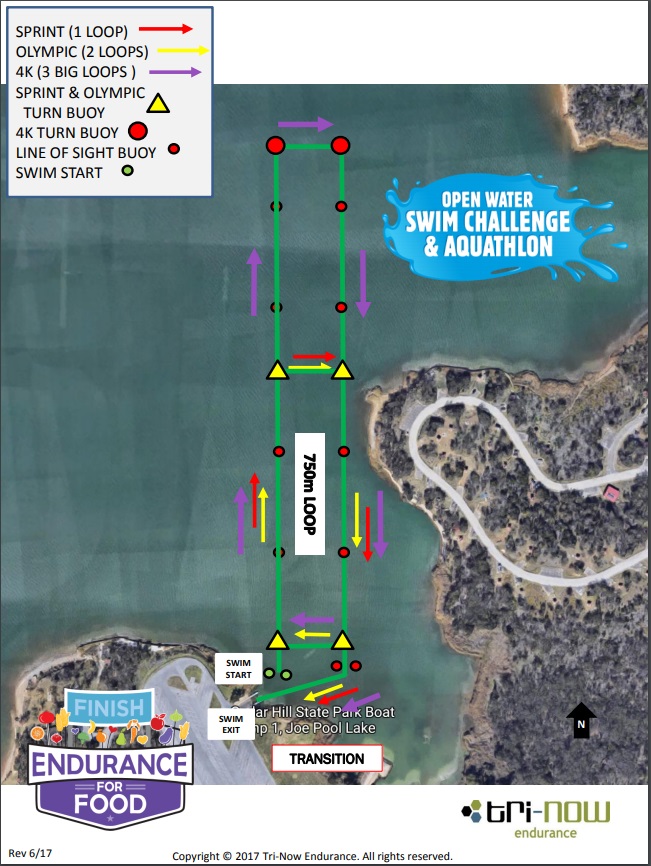
Race route. Image: Tri-Now Endurance, http://tri-now.com
This is Passport to Texas
Elite and casual athletes come together July 29th at Cedar Hill State Park for the Open Water Swim Challenge and Aquathlon. It’s a multisport competition of swimming, running and biking.
As part of their Year of Epic Texas Challenges—Texas Parks and Wildlife magazine’s July issue features an article about the event by Lisa Wyatt Roe. She penned a compelling piece about open water swimming, which is the feral cousin of lane swimming, as it doesn’t provide the ropes and walls that keep swimmers on course.
Roe introduces readers to competitors and experts who offer their rationale for taking on this unpredictable challenge, and how—for some—panic is their worst enemy.
She also offers readers Open Water Racing tips, including:
To keep yourself swimming in a straight line, use a landmark as a spot — a building or a buoy, for example.
Strive for a fluid, smooth rhythm. Do five to 10 strokes, then pop your head out of the water like a prairie dog to see where you are.
Know that you’ll get kicked. Roll with it.
Read additional open water racing tips and the fascinating story about the Open Water Swim Challenge and Aquathlon by Lisa Wyatt Roe in the July issue of Texas parks and Wildlife Magazine. On Newsstands now.
For Texas Parks and Wildlife…I’m Cecilia Nasti.
Posted in Events, State Parks, Swimming | Comments Off on TPW Magazine: Aquathlon Open Water Swim
July 2nd, 2018

Leave fireworks to the pros.
This is Passport to Texas
When it comes to celebrating our nation’s birthday at Texas state parks, go on and bring the barbeque, the watermelon and the outdoor games…but not the fireworks.
It is illegal in Texas state parks…it is a Class C misdemeanor to possess fireworks in a state park.
We’re not trying to put a damper on your Independence Day fun, but Wes Masur, state park law enforcement coordinator at Texas Parks and Wildlife, says parks are no place for fireworks. Even sparklers get two thumbs down.
Within the state park system we have different types of wildlife and different types of grasses and we don’t want to get any type of forest fire started…people are there to enjoy the state parks.
Devastating wildfires have started for much less. While some state parks do offer organized fireworks displays, not everyone appreciates these holiday pyrotechnics even when allowed.
Some people don’t like fireworks…the noises that go along with that stuff—we just don’t allow it in the state parks.
Find out which state parks offer public fireworks displays, at the Texas Parks and Wildlife website.
Our series receives support in part by RAM Trucks: built to serve.
For Texas Parks and Wildlife…I’m Cecilia Nasti.
Posted in Events | Comments Off on Does and Don’ts for Fourth of July Fun in Parks


 Passport to Texas is a
  Passport to Texas is made available by: