November 8th, 2012
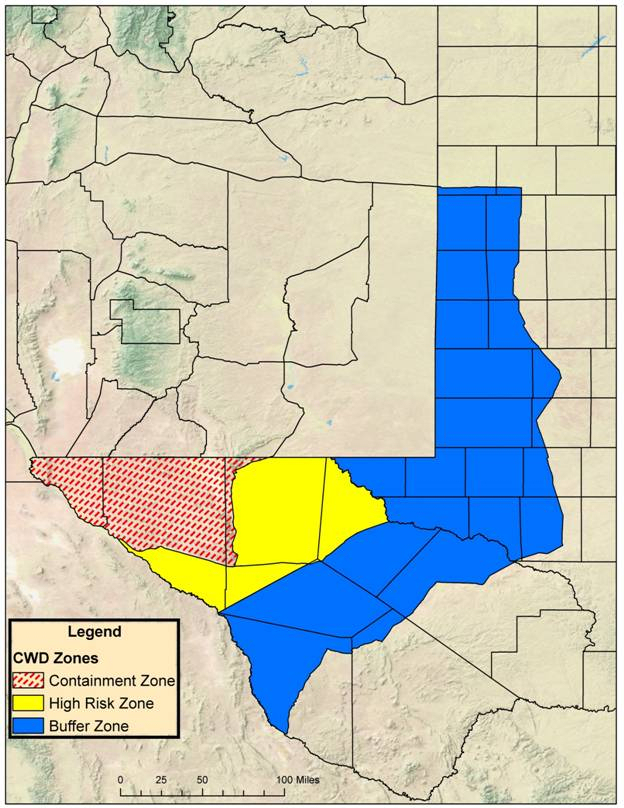
CWD Containment, High Risk & Buffer Zones
Passport to Texas with support from the Wildlife and Sport Fish Restoration Program
Chronic Wasting Disease (CWD) is fatal to deer infected with it, but is not known to be transmissible to other animals or humans. Detected earlier this year in far West Texas, hunters may harvest deer from that area, with this caveat:
14— As far as hunters are concerned, the only changes that we have proposed at this time is that for any deer that is harvested in a containment zone, we are requiring that those deer be presented at a check station.
Mitch Lockwood is Texas parks and Wildlife big game program director. The containment zone is where the disease was first identified in the state.
18 – We have two check stations established for the mule deer season this year: one being in van Horn and one being in Cornudas. And, so any deer that’s harvested within that containment zone, those deer would need to be presented at the check station, where we would collect a CWD sample.
Lockwood says voluntary check stations will be set up in the high risk and buffer zones, which are adjacent to the containment zone.
14 –Texas Parks and Wildlife department will pay for the test and we will post the testing results on the website so hunters can find out the test results from the deer they harvested just as soon as they’re made available from the lab.
It will take about two weeks for results to be posted. Go to the Texas Parks and Wildlife website for more information about the CWD management strategy.
The Wildlife and Sport Fish Restoration Program…supports our series and funds diverse conservation projects throughout Texas…
For Texas Parks and Wildlife…I’m Cecilia Nasti.
Posted in Hunting, Wildlife | Comments Off on Wildlife: Hunting in a Time of CWD
November 7th, 2012

Deer with CWD
Passport to Texas with support from the Wildlife and Sport Fish Restoration Program
The New Mexico Department of Game & Fish contacted Texas Parks and Wildlife earlier this year with some concerning news:
18— Back in February of this year, we received a call from NM Game & Fish, notifying us that they had detected CWD (Chronic Wasting Disease) in three of four hunter harvested deer within 2 miles of our border in the Hueco Mountains. So, that certainly grabbed out attention.
Mitch Lockwood, Texas Parks and Wildlife big game program director, says the state’s management strategy for dealing with Chronic Wasting Disease has been updated to include three zones: containment, where the disease is known to exist; high risk, where no infected animals have been discovered, but the likelihood is high; and…
14 – Adjoining the high risk zone is an area we call the buffer zone, which is an area of less risk when compared to the containment zone or high risk zone, but there’s still an elevated risk of CWD occurring there as compared to the rest of the state.
This week the Texas Parks and Wildlife commission will consider a proposal to prohibit transport of deer in and out of the containment zone… limited transport of deer from captive facilities in the high risk zone with increased testing of animals…and it would also allow for the trapping and transport of wild deer in the buffer zone.
05 …but not until an adequate number of CWD tests have been performed for that population.
And what about hunters who harvest deer in these zones? We’ll tell you about that tomorrow.
The Wildlife and Sport Fish Restoration Program…supports our series and funds diverse conservation projects throughout Texas…
For Texas Parks and Wildlife…I’m Cecilia Nasti.
Posted in Hunting, Wildlife | Comments Off on Wildlife: Stopping the Spread of CWD
November 6th, 2012
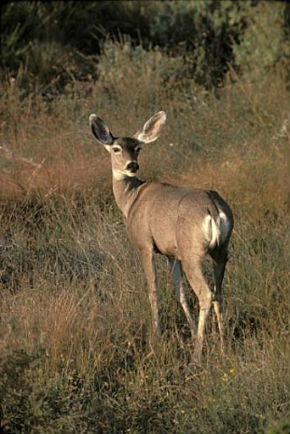
Mule Deer
Passport to Texas with support from the Wildlife and Sport Fish Restoration Program
Mule deer taken earlier this year from the Hueco Mountains in Far West Texas tested positive for Chronic Wasting Disease.
15—It’s what they call a transmissible spongiform encephalopathy, or TSE, which is similar to scrapie in sheep or BSE [mad cow disease] in cattle. I think it’s important to note that CWD is not known to infect livestock or humans for that matter.
Mitch Lockwood is Texas Parks and Wildife big game program director. The agency sampled more than 26-thousand hunter-harvested deer for the disease over the past decade; this recent discovery marks the first known cases inside Texas.
30—The incubation period for CWD is long. It can be two to three years, and it could possibly be longer than that in some cases. And so that’s one of the challenges of the disease; the deer doesn’t show any outward signs of being infected. There could be a long time between the deer actually being infected with CWD…before it actually shows any outward sign. So, that disease is able to manifest itself long before we detect that disease in the population.
In the latter stages of the diseases, symptoms may include listlessness, weight loss, weakness, and no fear of humans. Contact Parks and Wildlife is you encounter a deer displaying these symptoms.
Tomorrow: the CWD management strategy.
The Wildlife and Sport Fish Restoration Program…supports our series and funds diverse conservation projects throughout Texas…
For Texas Parks and Wildlife…I’m Cecilia Nasti.
Posted in Hunting, Wildlife | Comments Off on Wildlife: What is Chronic Wasting Disease
November 5th, 2012

Hiking in State Parks
This is Passport to Texas
It’s finally cool enough to do some serious hiking in state parks…and there’s plenty to see when you go…especially if you’re on the lookout for the state’s abundant wildlife. It’s cool enough for them to be milling around, now, too. Our state Park Guide, Bryan Frasier tells us more.
47— I’m so glad we’re doing a show on this, because it’s one of the most enjoyable experiences that you can do outdoors — and one of the most popular. And it’s great for kids. I was out the other day in a greenbelt, looked up into a big live oak tree, and there was a gray fox sitting in the tree. We’re blessed with a variety of wildlife, and if you walk slowly and look through the tree lines and just see…the excitement that kids experience when they observe wildlife like that in the woods — for the first time sometimes — there’s no experience like it. And it’s just a real discovery moment for them, and good for everyone. So, when you’re outside and enjoying the great weather here in the fall in Texas, take time to see the wildlife that are already there. It will really enrich your already great hiking experience.
Thanks, Bryan.
That’s our show for today…with funding provided by Chevrolet, supporting outdoor recreation in Texas; because there’s life to be done.
For Texas Parks and Wildlife…I’m Cecilia Nasti.
Posted in State Parks | Comments Off on State Parks: Wildlife Hikes
November 2nd, 2012

Brown-headed Cowbird
This is Passport to Texas Supported by the Wildlife and Sport Fish Restoration Program
Calling a brown-headed cowbird a cowbird, is a misnomer as far as biologist Marsha May is concerned.
I think they should be called bison birds, and not cowbirds, because they evolved with the bison.
Semantics aside, the bird’s habit of laying its eggs in other birds’ nests can cause the decline of species with small populations, such as the endangered Black-capped Vireo. Additional species are also affected.
Woodland species are now being impacted by brown-headed cowbirds, because we’ve fragmented the woods. Previously those woodland species were protected by the woods. Now that it’s fragmented, the cowbirds are getting into that habitat, and they’re parasitizing birds that have never historically been parasitized before.
The cowbird is in the blackbird family. The male has a black body and brown head, while the female is mottled brown and gray. Want to intervene on songbirds’ behalf.
You can actually become certified in Texas to trap for cowbirds, and that’s mainly during the breeding season, between March first and May thirty-first. And, mainly you’re trying to trap the females.
Get ready for spring. Find certification information on the Texas Parks and Wildlife website.
That’s our show… the Wildlife and Sport Fish Restoration Program supports our series and is funded by your purchase of shooting and hunting equipment and motorboat fuel.
For Texas Parks and Wildlife…I’m Cecilia Nasti.
Posted in Wildlife | Comments Off on Wildlife: Cowbirds Gaining Ground


 Passport to Texas is a
  Passport to Texas is made available by: